Keeping a school clean is more complicated than most people outside education realise. Between classrooms, staff rooms, toilets, canteens, halls and outdoor areas, school facilities managers and principals juggle a lot of moving parts. If you’re responsible for cleaning at a Perth school, whether public, private, or independent, you’ve probably asked some version of the questions below.
This FAQ pulls together the questions we hear most often from Perth schools, covering everything from scheduling to cost to compliance. It’s written to give you straightforward, practical answers you can actually use when planning or reviewing your school’s cleaning arrangements.
Frequency, Scheduling and Scope
How often should classrooms be cleaned?
Most Perth schools have classrooms cleaned once every school day, typically after hours so cleaning doesn’t disrupt lessons. This usually includes emptying bins, vacuuming or mopping floors, wiping down high-touch surfaces like door handles and light switches, and general tidying. Some schools add a midday touch-up for high-traffic classrooms, particularly in primary settings where younger children spend more time on the floor.
Do toilets and high-touch areas need cleaning more than once a day?
Yes, in most cases. Toilets, especially in primary schools, are usually checked and cleaned at least twice during the school day in addition to a thorough clean after hours. High-touch surfaces such as door handles, handrails, taps and light switches also benefit from more frequent attention, particularly during winter and flu season.
What about school holidays? Does cleaning stop?
Not entirely. Holiday periods are actually when a lot of the heavier work happens. Deep cleaning, floor stripping and resealing, carpet cleaning, window cleaning and pest control are usually scheduled during term breaks when classrooms are empty and there’s no risk of disrupting students or staff. Regular daily cleaning generally scales back or stops when the school is closed, unless there are holiday programs or vacation care running on site.
Should cleaning schedules differ between primary and secondary schools?
Often yes. Primary schools tend to need more attention to toilets, sick bays and classroom floors due to younger children. Secondary schools usually have larger common areas, science labs, canteens and sporting facilities that need their own cleaning protocols. A good cleaning provider will tailor the schedule to your school’s layout and student age group rather than applying a one-size-fits-all approach.
Who decides what’s included in the scope of work?
This is agreed between the school and the cleaning provider before the contract starts, usually documented in a cleaning specification or schedule. It should clearly list which areas are cleaned, how often, and to what standard. If your current arrangement doesn’t have a written scope of work, it’s worth asking for one. It removes ambiguity and gives you something to refer back to if standards slip.
Can specific areas be added or removed from the schedule as needs change?
Yes, most contracts allow for adjustments. Schools change over time: new buildings open, portables get removed, enrolment numbers shift. A reasonable cleaning provider should be able to adjust the scope without requiring a full contract renegotiation, though larger changes may affect pricing.
Cost, Staffing and Contract Questions
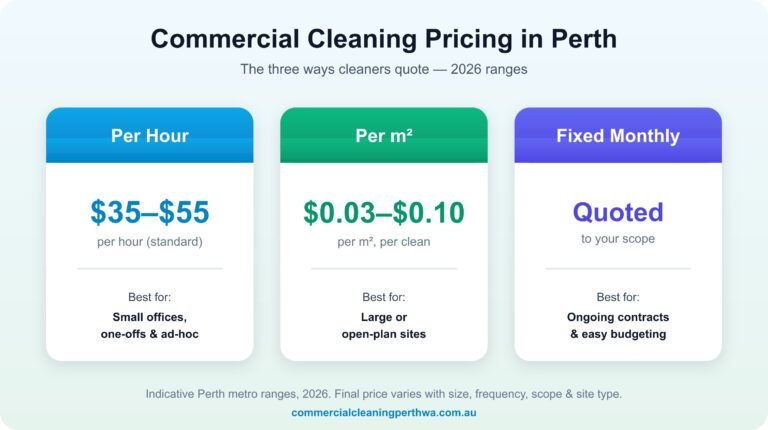
How is school cleaning usually priced?
Pricing generally depends on a few factors:
- The total floor area to be cleaned
- The frequency of cleaning (daily, weekly, or a combination)
- The number of specialist tasks included, such as carpet or window cleaning
- Whether cleaning happens during school hours, after hours, or both
- Consumables, such as toilet paper, soap and bin liners, if these are included
Because every school’s layout and requirements differ, it’s difficult to give a single “average” price. The most reliable way to understand cost is to get a written quote based on a site walkthrough rather than a generic rate.
Should we choose the cheapest quote?
Not necessarily. A quote that’s significantly lower than others is worth questioning, as it may reflect fewer cleaning hours, lower staff pay rates, or a reduced scope of work that isn’t obvious on paper. It’s worth comparing quotes side by side against the same scope of work, rather than comparing bottom-line figures alone.
Are consumables like paper towels and soap usually included?
This varies by provider and contract. Some cleaning companies include the supply of basic consumables as part of their service, while others leave this to the school to manage separately. It’s a detail worth clarifying up front, since it affects both cost and the day-to-day reliability of supplies in busy toilets and staff areas.
Do school cleaners work during school hours or after hours?
Both models are common. After-hours cleaning is standard for the bulk of daily cleaning, since it avoids disrupting lessons. However, many schools also have a daytime cleaner or caretaker on site to manage spills, toilet checks, and anything that comes up during the school day. Larger schools often combine both approaches.
How are cleaning staff vetted for working in a school environment?
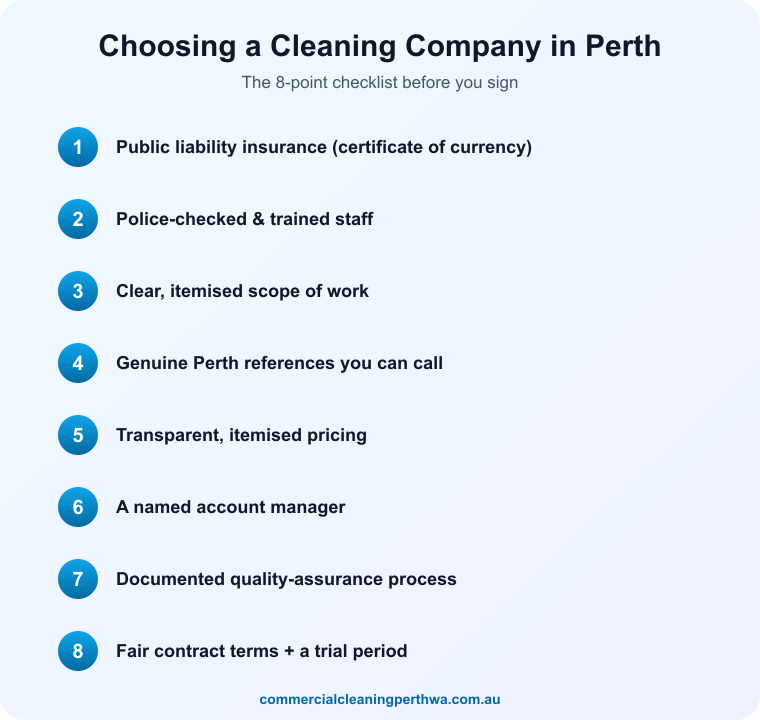
Reputable cleaning providers working in WA schools should ensure their staff hold a valid Working with Children Check, as this is a legal requirement for anyone working on school grounds during school hours in Western Australia. It’s reasonable for a school to ask its cleaning provider to confirm this as part of the contract, and to keep records on file.
What happens if a cleaner doesn’t turn up or there’s a staff shortage?
This should be addressed in the service agreement. Ask your provider how they handle absences, whether they have relief staff, and how quickly gaps are filled. Schools with tight budgets and busy facilities can’t afford unreliable cover, so this is a fair question to raise before signing a contract.
How long should a school cleaning contract run for?
Contract lengths vary, but many schools opt for a term of one to three years with a review period built in. Shorter terms give more flexibility if things aren’t working out, while longer terms can sometimes secure better pricing. Either way, make sure the contract includes a clear process for raising issues, requesting changes, or ending the arrangement if standards aren’t met.
What should be included in a service level agreement?
At minimum, a solid agreement should cover:
- The full scope of work and cleaning frequency
- Staffing arrangements, including WWCC compliance
- How complaints or quality issues are raised and resolved
- Insurance details, including public liability cover
- Pricing, payment terms and any review or escalation clauses
Health, Safety and Compliance Questions Specific to WA Schools
What cleaning products are safe to use around students?
Schools generally require cleaning providers to use products that are appropriate for use around children, correctly labelled, and stored securely away from student access. Chemicals should be stored in a locked area, and staff using them should be trained in correct handling and dilution. If your school has students with asthma or chemical sensitivities, it’s worth discussing product choice directly with your cleaning provider.
Are cleaning contractors required to follow WHS regulations in WA?
Yes. Cleaning contractors working in Western Australian schools are expected to comply with workplace health and safety obligations under WA’s work health and safety laws, the same as any other business operating on school premises. This includes safe handling of chemicals, proper use of equipment, and safe systems of work for tasks like working at height (for example, cleaning windows or light fittings).
Who is responsible for cleaning up bodily fluid spills, like vomit or blood?
This should be clearly defined in your cleaning contract. Many schools have their own first-response protocols for immediate spills during school hours, handled by school staff trained in basic spill kits, with the cleaning contractor responsible for the more thorough clean afterwards. It’s important this responsibility is documented so there’s no confusion about who acts first.
How does school cleaning support infection control?
Regular cleaning of high-touch surfaces, toilets and shared equipment plays a role in reducing the spread of common illnesses like colds and gastro, which circulate quickly in school environments. During periods of higher illness in the community, some schools increase the frequency of high-touch surface cleaning as a precaution. This should be flexible and discussed with your provider rather than fixed permanently into the contract.
Do cleaning staff need specific training for school environments?
Cleaning in a school setting requires a bit more awareness than a standard commercial site. Staff should understand child safety expectations, know how to store chemicals and equipment securely, and be briefed on school-specific procedures such as sign-in requirements and out-of-bounds areas. Ask your provider what induction or training their staff receive before starting work at a school.
Is public liability insurance required for school cleaning contractors?
Yes, this is standard practice. Any contractor working on school grounds, including cleaning providers, should carry public liability insurance, and schools should ask to see a current certificate of currency before work begins. This protects the school in the event of accidental damage or injury connected to the cleaning work.
Who do we contact if cleaning standards drop or an issue needs reporting?
Your contract or service agreement should name a specific point of contact, whether that’s an account manager, site supervisor, or a direct phone line for reporting issues. If your current arrangement doesn’t have this clearly defined, it’s worth asking your provider to nominate one. Quick, direct communication makes it much easier to resolve problems before they affect the day-to-day running of the school.
Getting Cleaning Arrangements Right for Your School
Most of the questions above come down to the same underlying issue: clarity. Schools that have a clear, written scope of work, a properly documented contract, and an easy way to raise issues tend to have far fewer cleaning headaches than those working off informal or outdated arrangements.
If you’re reviewing your current cleaning setup or comparing providers for the first time, it’s worth working through these questions directly with any prospective contractor. A provider who can answer them plainly, without vague or evasive responses, is generally a good sign you’re dealing with a team that understands what school cleaning actually involves.