At some point, most Perth business owners and office managers ask the same question: should we hire our own cleaner, or bring in a professional cleaning company? It seems like a simple decision, but once you dig into the real costs, liability issues, and day-to-day quality differences, the answer often isn’t as obvious as it first appears.
This article breaks down both options honestly, without assuming one is automatically better than the other. Whether you’re running a small office in Fremantle or managing a multi-floor building in the CBD, the right choice depends on your size, budget, and how much time you want to spend managing the cleaning process itself.
The True Cost of In-House Office Cleaning
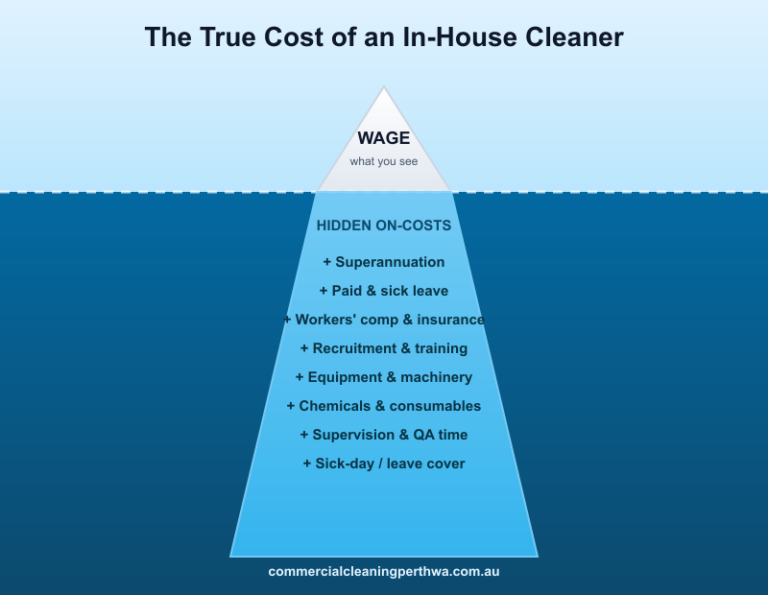
On paper, hiring a cleaner directly can look cheaper than paying a commercial cleaning contract. But the sticker price of an hourly wage rarely tells the whole story. When you employ someone directly, you’re taking on far more than just their pay.
Direct employment costs
- Wages, including penalty rates for early morning or after-hours shifts
- Superannuation contributions
- Annual leave and personal leave accrual
- Workers’ compensation insurance
- Payroll administration and record-keeping
These costs add up quickly, and they apply whether the cleaner is working a full shift or just an hour a day. For a small office, that can mean paying for far more time than you actually need, simply because a casual or part-time employee still comes with fixed obligations.
Equipment, consumables, and training
Beyond wages, someone needs to buy and maintain cleaning equipment, restock consumables like bin liners, hand soap, and paper towel, and train the cleaner on correct techniques for different surfaces and areas. If your in-house cleaner is new to the role, there’s also a learning curve before standards settle into a routine.
Vacuum cleaners, floor machines, microfibre systems, and chemical supplies aren’t expensive individually, but they represent an ongoing cost that many businesses forget to factor in when comparing the two options.
The cost of outsourcing to a professional cleaner
When you engage a professional office cleaning service in Perth, most of these overheads are bundled into a single, predictable invoice. The cleaning company handles staffing, insurance, equipment, and supplies. You’re paying for a completed service rather than an employee’s time, which makes budgeting simpler and removes the administrative burden entirely.
For many small and medium businesses, this is where outsourcing starts to look more cost-effective than it first appears, especially once you account for the hidden costs of managing an employee directly.
Quality, Consistency, and Liability: What Really Changes
Cost is only part of the equation. The bigger difference between in-house and outsourced cleaning often comes down to reliability and accountability.
Consistency of standards
An in-house cleaner is one person. If they’re sick, on leave, or leave the job altogether, your office cleaning either stops or falls to whoever happens to be around that day. There’s no backup system unless you’ve built one yourself, which usually means finding and training a second person just in case.
A professional commercial cleaning company, by contrast, operates with a team structure. If your regular cleaner is unavailable, another trained staff member steps in, usually following the same checklist and standards. This kind of built-in redundancy is difficult to replicate with a single internal hire.
Supervision and quality control
Who checks that the cleaning has actually been done properly? In many small offices, nobody formally does. With an in-house arrangement, quality often depends on how conscientious the individual cleaner is, and any issues might only surface when someone complains.
Established Perth commercial cleaners typically build quality checks into their service, whether that’s site inspections, supervisor walkthroughs, or standardised checklists for each visit. This doesn’t guarantee perfection, but it does mean there’s a structured process behind the results, rather than relying on one person’s habits.
Liability and compliance
This is where the gap between the two options becomes most significant. When you employ a cleaner directly, your business carries the liability for workplace injuries, correct handling of cleaning chemicals, and compliance with work health and safety obligations. If your cleaner is injured using a piece of equipment or a chemical product, that’s your responsibility to manage.
A licensed professional cleaning company carries its own insurance and is responsible for training its staff in safe work practices, correct chemical handling, and use of equipment. This shifts a meaningful amount of risk away from your business and onto a provider whose core operation is built around managing exactly these issues.
For businesses in shared office buildings, strata-managed premises, or industries with specific hygiene requirements, this distinction matters even more. Getting compliance wrong isn’t just inconvenient, it can create real exposure for the business.
Which Option Makes Sense for Your Business?
There’s no single right answer here. The best choice depends on the size of your office, your budget, and how much internal capacity you have to manage a cleaning function on top of everything else.
When in-house cleaning can make sense
- Very small offices with minimal cleaning needs, where a shared responsibility roster among staff is genuinely workable
- Businesses with an existing team member who has capacity to take on light cleaning duties as part of a broader role
- Organisations with highly specific or sensitive cleaning requirements that they prefer to control directly, such as certain medical or laboratory settings
Even in these cases, it’s worth being realistic about whether cleaning is being done to a genuinely professional standard, or simply “good enough” because nobody has flagged a problem yet.
When professional office cleaning makes more sense
- Small to medium businesses that want predictable costs without the administrative load of managing an employee
- Offices that need cleaning outside standard business hours, early mornings, evenings, or weekends
- Larger offices or multi-tenant buildings where consistency across large areas is difficult to manage with one or two internal staff
For most Perth SMEs, outsourcing tends to be the more practical option once staff numbers grow beyond a handful of people, or once the business occupies enough floor space that cleaning becomes a genuine time commitment rather than a quick daily task.
Larger offices and multi-site businesses
For larger operations, the case for professional office cleaning becomes even stronger. Coordinating cleaning across multiple floors, tenancies, or locations is a logistical task in itself. A professional cleaning company can standardise service levels across every site, provide consistent reporting, and adjust staffing based on your building’s actual usage patterns, something that’s far harder to manage with a small in-house team stretched across multiple locations.
A practical middle ground
Some Perth businesses land on a hybrid approach: an internal team member handles light daily tidying, such as wiping down shared kitchen areas or emptying small bins, while a professional cleaning service is contracted for deeper, scheduled cleans covering floors, bathrooms, and common areas. This can work well for businesses that want some day-to-day control without taking on the full liability and administrative load of a dedicated cleaning employee.
Making the Decision
Before deciding, it’s worth asking a few honest questions:
- How much time is currently spent managing cleaning tasks, rosters, or supply orders internally?
- What would happen to your cleaning standards if your current cleaner left tomorrow?
- Are you confident your business is meeting its work health and safety obligations around chemical use and equipment?
- Would a fixed, predictable invoice be easier to manage than variable staffing costs?
If those questions raise more uncertainty than confidence, it’s a reasonable signal that outsourcing to a professional office cleaning provider in Perth is worth serious consideration. If your current in-house setup is working well and your office is small enough to manage comfortably, there may be no urgent need to change.
Frequently Asked Questions
Is professional office cleaning more expensive than hiring an in-house cleaner?
Not necessarily. While the hourly rate for a contracted cleaning service can look higher than a wage, in-house cleaning carries additional costs like superannuation, leave entitlements, insurance, and equipment that aren’t always factored into initial comparisons. Once these are included, outsourcing is often comparable or more cost-effective, particularly for smaller offices.
Who is responsible if an in-house cleaner is injured at work?
As the employer, your business carries responsibility for workplace health and safety, including proper training on chemical handling and equipment use. This is a meaningful liability that professional cleaning companies typically manage themselves through their own insurance and staff training.
Can a professional cleaning service work around our business hours?
Most commercial cleaning providers in Perth offer flexible scheduling, including early morning, evening, or after-hours cleaning, so the office isn’t disrupted during working hours. This is worth discussing directly with any provider before signing a contract.
Is it possible to switch from in-house to professional cleaning without disruption?
Yes, most businesses transition gradually by running a trial period or overlapping the handover so cleaning standards and building access are properly established before fully switching over.
What size office justifies outsourcing cleaning?
There’s no fixed threshold, but once cleaning starts taking up more than a small amount of time each day, or once staff numbers grow past a small team, many businesses find outsourcing simplifies operations and improves consistency.