Walk down any street in Perth’s CBD, or through a suburban shopping strip in Joondalup or Fremantle, and you’ll pass dozens of businesses that all share one thing in common: none of them run well in a dirty space. Yet the question of who actually needs commercial cleaning, and how often, isn’t always obvious. Some businesses assume a weekly vacuum is enough. Others discover too late that their industry carries specific hygiene obligations they weren’t meeting.
This guide breaks down which industries in Perth rely on commercial cleaning, why the requirements shift depending on your business type, and how to tell if your operation is overdue for a proper cleaning schedule.
Core Industries in Perth That Rely on Commercial Cleaning
Almost every business benefits from a clean workspace, but some industries have needs that go well beyond appearances. Here’s a look at the sectors that most commonly engage commercial cleaning services in Perth.
Offices and Corporate Workspaces
Office cleaning is often the first thing people think of, and for good reason. Shared desks, meeting rooms, kitchens, and bathrooms all see constant use throughout the working week. Dust build-up on surfaces, fingerprints on glass partitions, and grime in break rooms don’t just look bad to visiting clients, they contribute to a less healthy environment for staff.
Offices across Perth’s business districts, from West Perth to the Perth CBD, typically schedule cleaning several times a week, with high-traffic areas like reception and kitchens needing daily attention.
Retail Stores and Shopping Centres
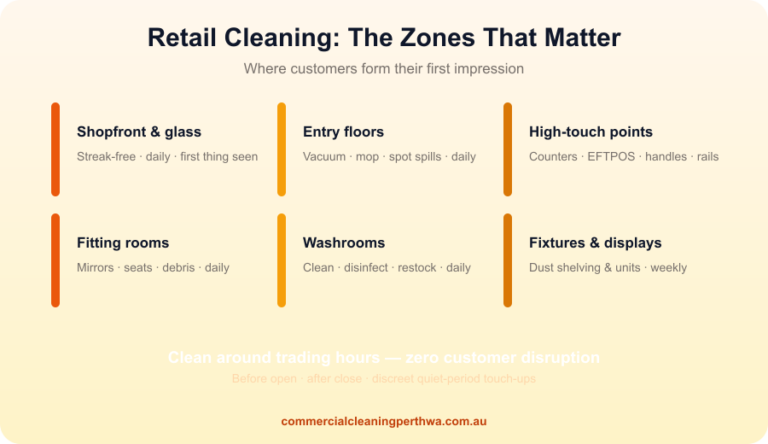
Retail spaces face a different challenge: constant foot traffic from the public. Floors need regular mopping and vacuuming, glass doors and windows need to stay streak-free, and change rooms and counters require frequent wiping down. A retail store that looks unkempt can quietly turn customers away before they’ve even browsed the shelves.
Retail cleaning schedules in Perth often run daily, particularly for stores in busy centres like Garden City or Karrinyup, where dust and marks accumulate quickly.
Healthcare and Medical Facilities
Medical clinics, dental practices, allied health centres, and aged care facilities operate under a different level of scrutiny. Cleaning here isn’t just about presentation, it’s tied to infection control and patient safety. Waiting rooms, treatment areas, and shared equipment all need cleaning protocols that go beyond a standard commercial clean.
Healthcare providers in Perth generally require cleaning teams familiar with medical-grade hygiene standards, including appropriate handling of clinical waste and high-touch surface disinfection.
Hospitality Venues
Cafes, restaurants, pubs, and hotels deal with food preparation areas, dining spaces, and bathrooms that all need to meet health standards while still looking presentable to guests. In hospitality, cleanliness is directly linked to reputation. A sticky table or a poorly maintained bathroom can undo the effect of great food and service.
Many hospitality venues in Perth combine an in-house end-of-shift clean with a scheduled deep clean from a commercial cleaning provider to manage areas like kitchen exhausts, grout, and storage rooms.
Industrial and Warehouse Facilities
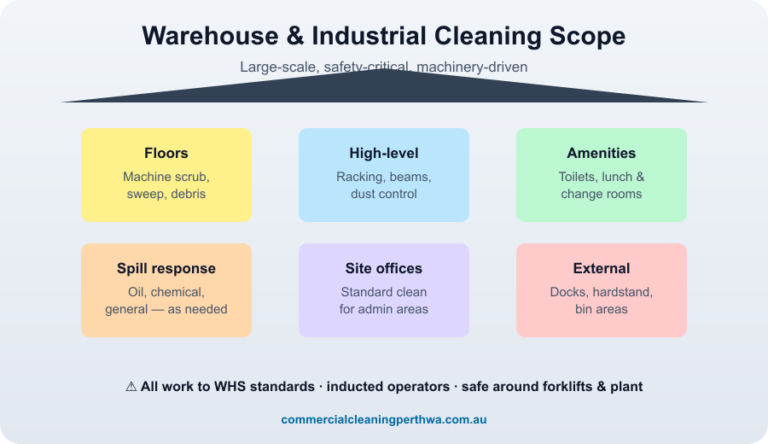
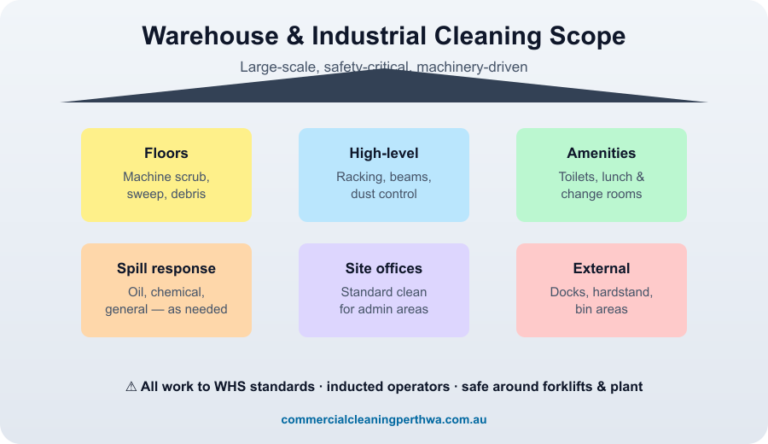
Warehouses, factories, and logistics hubs across Perth’s industrial areas such as Kewdale and Welshpool have their own cleaning demands. These sites deal with dust, oil residue, packaging debris, and heavy equipment. Cleaning here is less about aesthetics and more about safety, keeping floors free of hazards and ensuring machinery areas don’t become fire or slip risks.
Education and Childcare Centres
Schools, childcare centres, and training facilities in Perth need cleaning regimes built around large numbers of children and young people moving through shared spaces. Classrooms, toilets, and communal areas all need regular disinfection, particularly during cold and flu season, to reduce the spread of illness.
How Cleaning Requirements Vary by Industry
Not every business needs the same cleaning frequency or approach. Three factors tend to shape what a business actually requires: size, foot traffic, and compliance obligations.
Business Size and Layout
A small boutique office with five staff has very different needs to a multi-storey commercial building with hundreds of employees and shared facilities. Larger sites usually need cleaning teams that can work efficiently across multiple floors, often outside business hours to avoid disrupting operations.
Foot Traffic Levels
The number of people passing through a space each day has a direct impact on how often cleaning is needed. Consider the difference between:
- A professional services office with a handful of client visits per week
- A retail store seeing hundreds of customers daily
- A medical clinic with a steady stream of patients from opening to close
Higher foot traffic means faster wear on floors, more fingerprints on surfaces, and a greater need for restocked supplies like hand soap and paper towels. Businesses with heavy foot traffic generally need daily cleaning, while lower-traffic offices might manage with a few visits a week.
Compliance and Industry Standards
Some industries have obligations that go beyond general tidiness. Healthcare and food service businesses, for example, need to meet hygiene standards relevant to their sector, which often means:
- Using approved disinfectants on specific surfaces
- Following documented cleaning schedules for audit purposes
- Training cleaning staff in correct waste handling procedures
- Maintaining records that demonstrate consistent cleaning practices
Businesses in these sectors typically need a commercial cleaning provider that understands these requirements and can work within them, rather than a general clean that overlooks compliance-sensitive areas.
Signs Your Business Would Benefit From a Scheduled Cleaning Programme
Some businesses handle cleaning on an ad hoc basis for years before realising a proper schedule would save time, money, and hassle. Here are some common signs it’s worth setting one up.
Staff Are Spending Time Cleaning Instead of Working
If team members are regularly wiping down surfaces, taking out bins, or vacuuming between tasks, that’s time and focus pulled away from the work they were hired to do.
Customers or Clients Have Commented on Cleanliness
Feedback, even informal comments, about a messy bathroom, dusty shelves, or a grubby entrance is a clear signal that current cleaning arrangements aren’t cutting it.
Your Business Sees Consistent Foot Traffic
If your space is used daily by staff, customers, or patients, sporadic cleaning simply can’t keep pace. A set schedule, whether that’s daily, several times a week, or a rotating deep clean, matches cleaning frequency to actual usage.
You’re in a Regulated Industry
Healthcare, food service, childcare, and aged care businesses in Perth generally need documented, consistent cleaning practices to meet their sector’s expectations. If you’re relying on whoever has time to grab a mop, that’s a gap worth closing.
You’ve Recently Grown or Moved Premises
A larger space, more staff, or a new location often changes cleaning needs overnight. What worked for a small office might not stretch to cover a bigger footprint.
Cleaning Feels Inconsistent
If some weeks the office looks great and other weeks it doesn’t, that inconsistency usually points to an informal approach rather than a structured one. A scheduled commercial cleaning programme irons out these gaps by setting clear expectations for frequency and scope.
Choosing the Right Approach for Your Business
There’s no single answer to who needs commercial cleaning in Perth, because almost every industry benefits from it in some form. The real question is how often, and to what standard. An office might need a clean three times a week, while a medical clinic needs daily attention to high-touch surfaces. A warehouse might need a monthly deep clean of floors and storage areas, while a cafe needs daily attention to kitchen and dining spaces.
Matching the cleaning schedule and approach to your specific industry, size, and foot traffic is what makes the difference between a business that merely looks clean and one that actually maintains consistent hygiene standards day to day.
Frequently Asked Questions
How often should a Perth office be professionally cleaned?
Most offices benefit from cleaning several times a week, with high-use areas like kitchens and bathrooms needing daily attention. The right frequency depends on staff numbers and how much the space is used.
Do small businesses need commercial cleaning, or is that only for large companies?
Small businesses can benefit just as much as large ones. A small retail store or clinic still deals with foot traffic and hygiene expectations, just on a smaller scale, which usually means a shorter clean rather than no clean at all.
What’s the difference between general cleaning and industry-specific cleaning?
General cleaning covers everyday tidiness, dusting, vacuuming, and rubbish removal. Industry-specific cleaning, such as for healthcare or food service, includes additional steps like surface disinfection and compliance-related documentation to meet sector expectations.
How do I know if my business needs daily cleaning or just a few times a week?
Foot traffic is the biggest indicator. Businesses with constant visitor or customer numbers, like retail stores and clinics, usually need daily cleaning, while lower-traffic offices can often manage with a few scheduled visits weekly.