Industrial cleaning in Perth covers large-scale, safety-critical cleaning of warehouses, factories and workshops — machine-scrubbed floors, dust and debris control, high-level cleaning, washrooms and amenities, and spill response — carried out to WHS standards around live operations. It's a different discipline to office cleaning, needing the right machinery, trained operators and a strong safety focus. Here's what's involved.
Why industrial cleaning is a specialist job
A warehouse isn't just a big office. The scale, floor types, machinery, dust loads and safety risks demand specialist equipment and methods:
- Ride-on / walk-behind scrubbers for large concrete floors, not mops and buckets.
- Dust and debris control to protect stock, equipment and air quality.
- Working safely around forklifts, racking and live plant — traffic management and site inductions matter.
- WHS compliance — the right PPE, chemical handling and spill procedures.
This is why industrial cleaning sits at a higher rate than standard commercial work — and why it should only be done by trained, inducted operators.
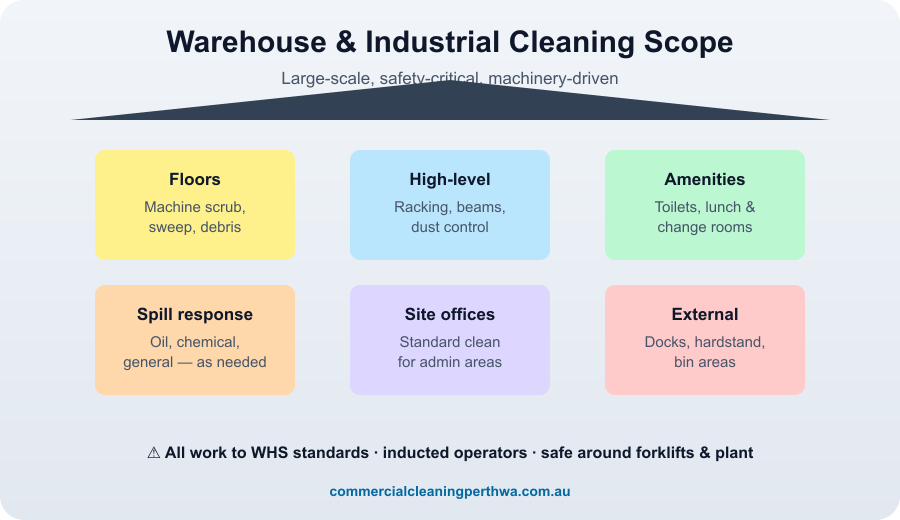
What a warehouse & industrial cleaning scope covers
| Area | Typical tasks | Frequency |
|---|---|---|
| Warehouse floors | Machine scrub, sweep, debris removal, line-marking care | Scheduled / periodic |
| Dust control | Racking, ledges, high surfaces, extraction where needed | Periodic |
| Amenities | Staff toilets, lunchrooms, change rooms | Daily/weekly |
| Offices on site | Standard office clean for admin areas | Daily/weekly |
| High-level cleaning | Beams, mezzanines, light fittings (access equipment) | Periodic |
| Spill response | Oil, chemical, general — per site procedures | As needed |
| External | Loading docks, hardstand, bin areas | Periodic |
Safety first: how good industrial cleaners work
For industrial sites, safety is the scope. A professional Perth provider will:
- Complete your site induction and follow site rules.
- Use traffic-management awareness around forklifts and vehicles.
- Carry the right insurance and SWMS (safe work method statements) for the tasks.
- Handle chemicals per Safe Work Australia guidance and SDS.
- Schedule disruptive work (floor scrubbing) around production windows.
Ask any provider how they manage safety on a live site — see our choosing a cleaner guide for the full vetting checklist.
Frequently asked questions
What does industrial cleaning include? Industrial cleaning covers machine-scrubbed warehouse floors, dust and debris control, high-level cleaning of racking and beams, staff amenities and on-site offices, spill response, and external areas like loading docks — all carried out to WHS standards around live operations.
How is industrial cleaning different from office cleaning? It's larger in scale and safety-critical. Industrial cleaning uses ride-on and walk-behind floor scrubbers rather than mops, requires dust control, safe work around forklifts and plant, site inductions, SWMS and specific PPE — none of which a standard office clean involves.
How often should a warehouse be cleaned? It depends on the operation. Staff amenities and offices are cleaned daily or weekly, while large floor scrubbing, high-level dust control and racking cleaning are scheduled periodically around production, with spill response handled as needed.
Do industrial cleaners need special equipment? Yes. Large concrete floors need industrial scrubbers rather than mops, high-level cleaning needs safe access equipment, and dust control may need extraction. Operators should also be trained and inducted for safe work around plant and vehicles.
Can cleaning be done without stopping production? Often yes. Disruptive tasks like floor scrubbing are scheduled around production windows or during quieter shifts, while amenities and office cleaning happen alongside operations with appropriate safety measures.