Medical and dental cleaning in Perth must go well beyond a standard office clean: it requires zoned cleaning (from low-risk offices to high-risk clinical areas), TGA-listed hospital-grade disinfectants, a colour-coded equipment system to prevent cross-contamination, and staff trained in infection-control protocols aligned to Australian standards. Getting this wrong risks patient safety, accreditation and your reputation. Here's what a compliant clean actually looks like.
For practice managers: the non-negotiables are risk-based zoning, TGA-listed disinfectants, colour-coded cloths/mops, trained + inducted cleaners, and documented cleaning logs for accreditation.
Why medical cleaning is different from office cleaning
A general office clean is about appearance and comfort. A clinical clean is about infection prevention and control (IPC) — reducing the transmission of pathogens between patients, staff and surfaces. That means:
- Cleaning is risk-based, not one-size-fits-all.
- Surfaces are cleaned and disinfected, in the correct order, with the correct products and contact ("dwell") times.
- Equipment is segregated so a cloth used in a bathroom never touches a treatment surface.
- Everything is documented to support accreditation.
This is why medical and dental cleaning sits at a higher price point than standard office work — and why it should only be done by trained, inducted cleaners.
Risk-based cleaning zones
Australian infection-control practice groups clinical areas by risk. Cleaning frequency and rigour scale with the zone:
| Risk zone | Examples | Approach |
|---|---|---|
| Low risk | Admin offices, waiting-room seating (non-clinical) | Routine clean, standard products |
| Moderate risk | Reception, corridors, patient toilets, general treatment rooms | Clean + disinfect high-touch points, daily minimum |
| High risk | Treatment/procedure rooms, dental surgeries, dressing areas | Clean + hospital-grade disinfect after each session/day, strict protocols |
High-touch points — door handles, light switches, chair arms, EFTPOS terminals, tap handles, treatment chairs — get priority attention in every zone because they're the main transmission route.
The colour-coded system that prevents cross-contamination
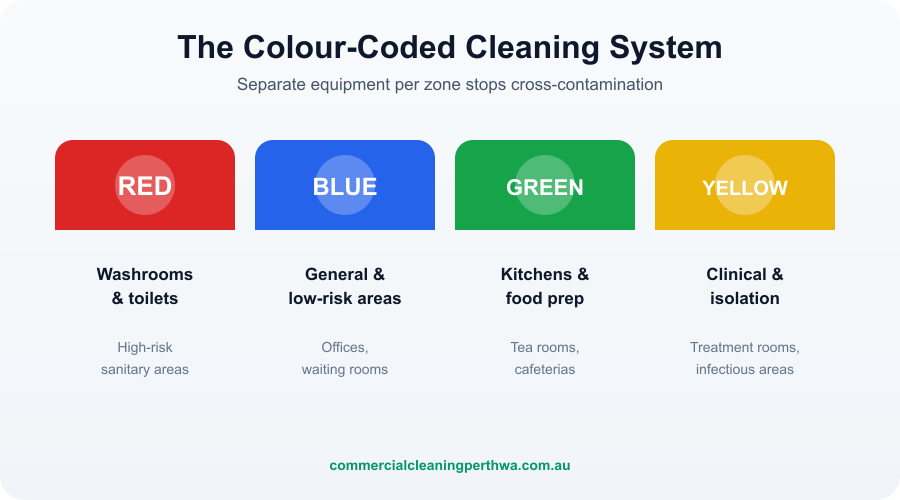
A cornerstone of compliant clinical cleaning is colour-coded equipment — separate cloths and mops for separate areas, so contamination can't travel. The widely used convention:
- Red — high-risk washrooms, toilets, sanitary fittings.
- Blue — general low-risk areas (offices, waiting rooms).
- Green — kitchens / food and beverage prep areas.
- Yellow — clinical / isolation and infectious areas.
Using the wrong cloth in the wrong zone defeats the entire system, which is why trained staff matter more here than anywhere.
Products: TGA-listed, hospital-grade disinfectants
Not every "disinfectant" is fit for clinical use. Compliant Perth medical cleaning uses TGA-listed hospital-grade disinfectants, applied with the correct dilution and left for the manufacturer's stated contact time — a surface wiped and immediately dried hasn't been disinfected. Surfaces are cleaned first (to remove organic matter) then disinfected, because disinfectants don't work properly on a dirty surface.
What should be included in a medical cleaning scope
A proper Perth clinical cleaning scope covers:
- Daily clean + disinfect of all high-touch surfaces in patient areas.
- Treatment/surgery rooms cleaned to protocol between sessions and end of day.
- Waiting rooms, reception and toilets on a defined frequency.
- Colour-coded equipment, changed and laundered/replaced appropriately.
- Clinical waste handling support per your practice's protocols (cleaners support, not replace, your clinical waste process).
- Floors cleaned and disinfected; spot response for spills.
- Documented cleaning logs for accreditation and audits.
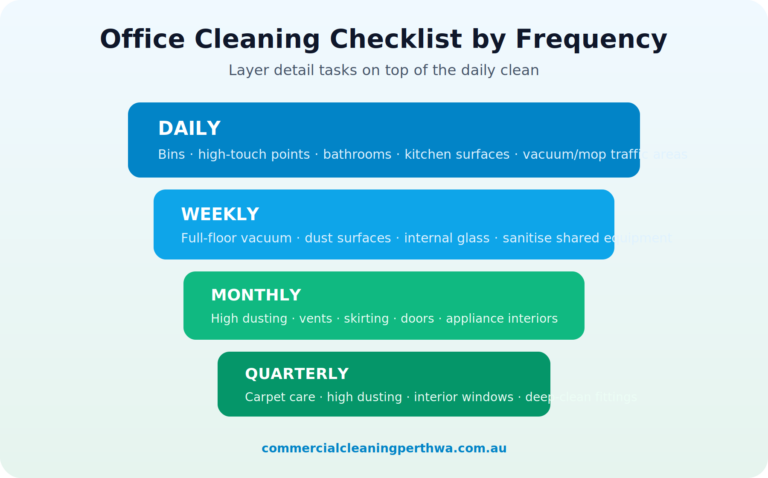
Compare this to a general office cleaning checklist and the difference in rigour is clear.
Standards and accreditation your cleaner should support
Medical and dental practices in Perth work to national infection-control expectations. Your cleaning provider should understand and support:
- NHMRC Australian Guidelines for the Prevention and Control of Infection in Healthcare (the national IPC reference).
- Relevant accreditation standards your practice is assessed against (e.g. RACGP / general practice, or dental board expectations).
- Safe Work Australia guidance for chemical handling and staff safety.
Cleaning logs and a documented method are what turn "we clean well" into audit-ready evidence.
Always align the final scope with your practice's own IPC lead and accreditation requirements — this guide is general and not a substitute for your practice's clinical policies.
Frequently asked questions
How is medical cleaning different from regular office cleaning? Medical cleaning is risk-based and focused on infection prevention, not just appearance. It uses TGA-listed hospital-grade disinfectants with correct contact times, colour-coded equipment to prevent cross-contamination, clinical-area protocols, and documented logs for accreditation — none of which a standard office clean requires.
What disinfectants should be used in a Perth medical centre? Compliant clinical cleaning uses TGA-listed hospital-grade disinfectants, applied at the correct dilution and left for the manufacturer's stated contact time. Surfaces are cleaned to remove organic matter first, then disinfected, because disinfectants are less effective on soiled surfaces.
What is the colour-coded cleaning system? It's a system of using separate coloured cloths and mops for different areas — commonly red for washrooms, blue for general areas, green for kitchens and yellow for clinical/infectious areas — so contamination can't transfer between zones. It's a core requirement of clinical cleaning.
How often should a dental practice be cleaned? High-risk areas like surgeries and treatment rooms are cleaned and disinfected between sessions and at the end of each day. Reception, waiting rooms and toilets are cleaned at least daily, with high-touch points prioritised throughout.
Do medical cleaners need special training? Yes. Clinical cleaners should be trained in infection-control protocols, correct use of the colour-coded system, hospital-grade disinfectant use and contact times, and safe chemical handling — as well as being police-checked for working in patient environments.