Most business owners assume office cleanliness is simply a matter of appearances. In reality, keeping a commercial workplace clean is tied directly to Australian workplace health and safety law. If you manage an office in Perth, understanding how office cleaning standards in Australia actually work can help you avoid compliance gaps, reduce staff illness, and protect your business if something goes wrong.
This guide breaks down what the law actually requires, what “minimum acceptable” cleaning looks like in a Perth commercial setting, and how to build a cleaning program that genuinely stands up to scrutiny.
Workplace Health and Safety Obligations Around Cleanliness
Australian workplaces operate under harmonised Work Health and Safety (WHS) laws, which in Western Australia are enforced through the Work Health and Safety Act and supporting regulations administered by WorkSafe WA. These laws don’t hand down a line-by-line cleaning schedule. Instead, they place a general duty on employers, known as a “person conducting a business or undertaking” (PCBU), to provide and maintain a work environment without risks to health and safety, so far as is reasonably practicable.
Cleanliness sits squarely inside this duty. A workplace that accumulates dust, mould, food waste, or unclean amenities can create genuine hazards, including:
- Respiratory irritation from dust, allergens, and poor air quality
- Increased transmission of colds, flu, and other infections
- Slip hazards from spills or wet flooring
- Pest attraction from food waste and poor kitchen hygiene
- Reduced amenity in bathrooms and shared facilities, which has its own hygiene implications
Codes of practice that support WHS legislation, such as those covering managing risks in workplaces and providing workplace facilities, reinforce the expectation that toilets, kitchens, break rooms, and general work areas are kept in a clean and hygienic condition. While these codes don’t specify an exact cleaning frequency, they are used as evidence of what a “reasonably practicable” standard looks like if an incident or complaint is ever investigated.
Why This Matters Beyond Compliance
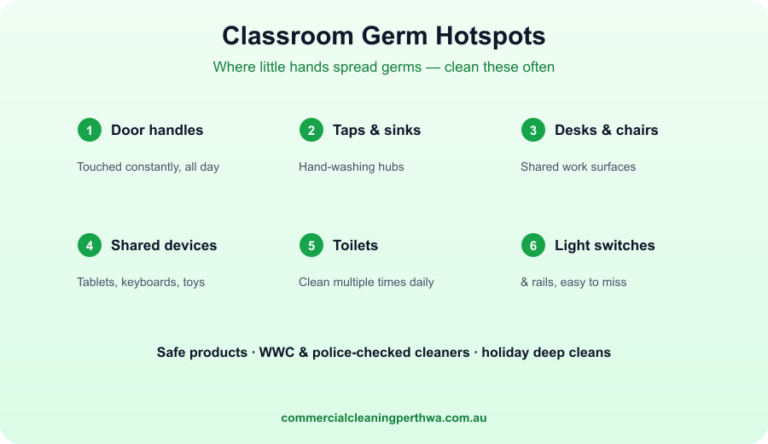
Beyond the legal angle, hygiene standards affect everyday staff wellbeing. Shared office equipment, kitchen surfaces, and high-touch points like door handles and lift buttons are well-recognised vectors for spreading illness in enclosed workplaces. A consistent cleaning program is one of the more straightforward ways an employer can reduce absenteeism linked to preventable illness.
Minimum Cleaning Frequencies and Documentation in Perth Commercial Environments
There is no single Australian standard that states “offices must be cleaned exactly this many times per week.” Instead, the appropriate frequency depends on factors such as staff numbers, foot traffic, building type, and how the space is used. That said, most Perth commercial properties operate to a set of widely accepted minimum practices that satisfy both landlord requirements and WHS expectations.
Typical Daily Cleaning Tasks
- Emptying general waste and recycling bins
- Vacuuming or mopping high-traffic floor areas
- Wiping down kitchen benchtops and sinks
- Cleaning and restocking bathroom facilities, including soap and paper products
- Spot-cleaning high-touch surfaces such as door handles, light switches, and shared equipment
Typical Weekly or Periodic Tasks
- Detailed dusting of desks, shelving, and skirting boards
- Cleaning internal glass and partitions
- Vacuuming upholstery and soft furnishings
- Sanitising rubbish bin interiors
- Deep cleaning of kitchen appliances such as microwaves and fridges
Longer-Cycle Tasks
- Carpet steam cleaning
- Window cleaning, internal and external
- Air conditioning vent and filter cleaning
- High dusting of ceilings, vents, and light fittings
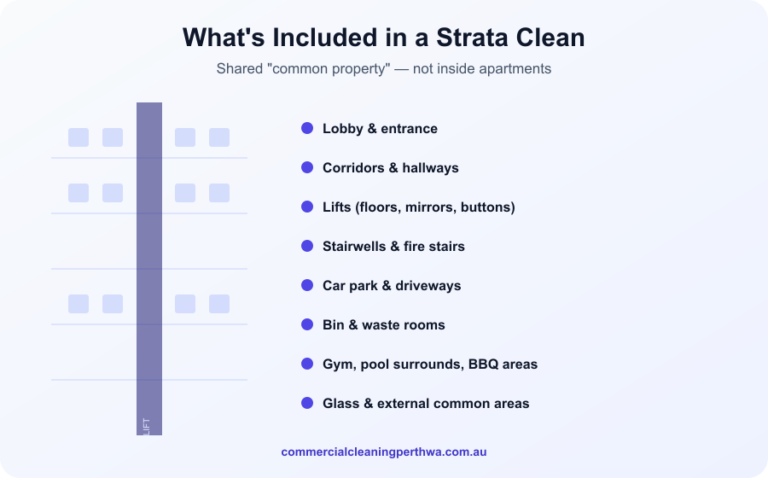
In multi-tenant Perth office buildings, base building cleaning of common areas (lobbies, lifts, shared bathrooms) is often managed by the building owner or strata, while tenant-specific cleaning inside your leased suite is typically your responsibility. It’s worth checking your lease agreement to confirm exactly where that line sits.
Documentation: The Part Many Businesses Miss
Cleaning frequency is only half the picture. From a WHS compliance standpoint, being able to demonstrate that cleaning actually happened is just as important as the cleaning itself. If a workplace incident, complaint, or audit occurs, documentation is what allows a business to show it took reasonable steps to maintain a safe environment.
Useful documentation practices include:
- A written cleaning schedule outlining tasks, frequency, and responsible parties
- Completed cleaning checklists or sign-off sheets for each visit
- Records of chemicals and products used, including safety data sheets (SDS) where required
- Incident or complaint logs relating to cleanliness or hygiene issues
- Contracts or service agreements with cleaning providers that outline scope and standards
Keeping this paperwork organised, even in a simple shared folder, gives a business a clear audit trail and makes it far easier to identify when standards have slipped.
Building an Office Cleaning Program That Meets Compliance and Protects Staff
A compliant cleaning program isn’t just about ticking boxes. It should be built around the actual risks present in your workplace and reviewed regularly as conditions change.
Step 1: Assess Your Workplace Risk Factors
Start by looking honestly at how your office is used. Relevant factors include:
- Number of staff and visitors moving through the space daily
- Whether staff eat at desks or in shared kitchen areas
- Presence of shared equipment, such as phones, keyboards, or printers
- Any staff with known health vulnerabilities
- Seasonal factors, such as increased flu transmission in winter
This assessment doesn’t need to be formal or complex, but it should inform how often certain tasks are scheduled.
Step 2: Set a Written Cleaning Schedule
Translate your risk assessment into a written schedule that specifies daily, weekly, and periodic tasks, along with who is responsible for each. Whether you use an in-house cleaner or an external commercial cleaning provider, having this in writing removes ambiguity and gives you a benchmark to measure performance against.
Step 3: Use Checklists and Sign-Offs
Simple, consistent checklists that are signed or logged after each clean create the documentation trail discussed earlier. This also helps quickly identify if a particular area, such as bathrooms or kitchen zones, is being missed or under-serviced.
Step 4: Review Supplier Agreements Regularly
If you outsource cleaning, your service agreement should clearly state the scope of work, frequency, and standards expected. Periodically reviewing this against what’s actually being delivered helps catch gaps before they become compliance issues or staff complaints.
Step 5: Encourage Staff Feedback
Employees are often the first to notice when cleaning standards slip, whether that’s an overflowing bin, a grubby kitchen, or a bathroom running low on supplies. A simple, low-friction way for staff to report issues (even just an email address or shared channel) helps you respond quickly and shows a genuine commitment to workplace hygiene, not just a paper compliance exercise.
Step 6: Revisit the Program as Conditions Change
Office layouts change, staff numbers grow, and usage patterns shift. A cleaning program that was adequate 12 months ago might no longer suit a bigger team or a busier space. Building in a periodic review, even once or twice a year, keeps the program aligned with actual conditions rather than outdated assumptions.
Bringing It All Together
Office cleaning standards in Australia aren’t defined by a single rulebook with exact frequencies, but by the broader WHS duty to maintain a safe, healthy workplace. For Perth businesses, that means combining sensible minimum cleaning practices with clear documentation and a program that’s actually reviewed and adjusted over time.
Getting this right isn’t complicated, but it does require intention. A written schedule, consistent checklists, and open communication with staff go a long way toward meeting compliance expectations while genuinely protecting the people who work in your space every day.
Frequently Asked Questions
Is there a specific Australian law that sets office cleaning frequencies?
No single law sets exact frequencies. Instead, WHS legislation requires employers to maintain a workplace without risks to health and safety, so far as is reasonably practicable, with codes of practice providing guidance on what that looks like for facilities and general hygiene.
Who is responsible for cleaning shared areas in a Perth office building?
This depends on your lease. Common areas like lobbies and shared bathrooms are usually managed by the building owner or strata, while cleaning inside your tenancy is typically your own responsibility. Always check your lease terms to confirm.
Do small offices need the same cleaning standards as large workplaces?
The underlying WHS duty applies regardless of size, but the appropriate frequency and scope of cleaning should reflect the actual risk profile of the workplace, including staff numbers and how the space is used.
What records should a business keep for cleaning compliance?
A written cleaning schedule, completed checklists or sign-off sheets, service agreements with cleaning providers, and any relevant incident or complaint logs are all useful records to maintain.