
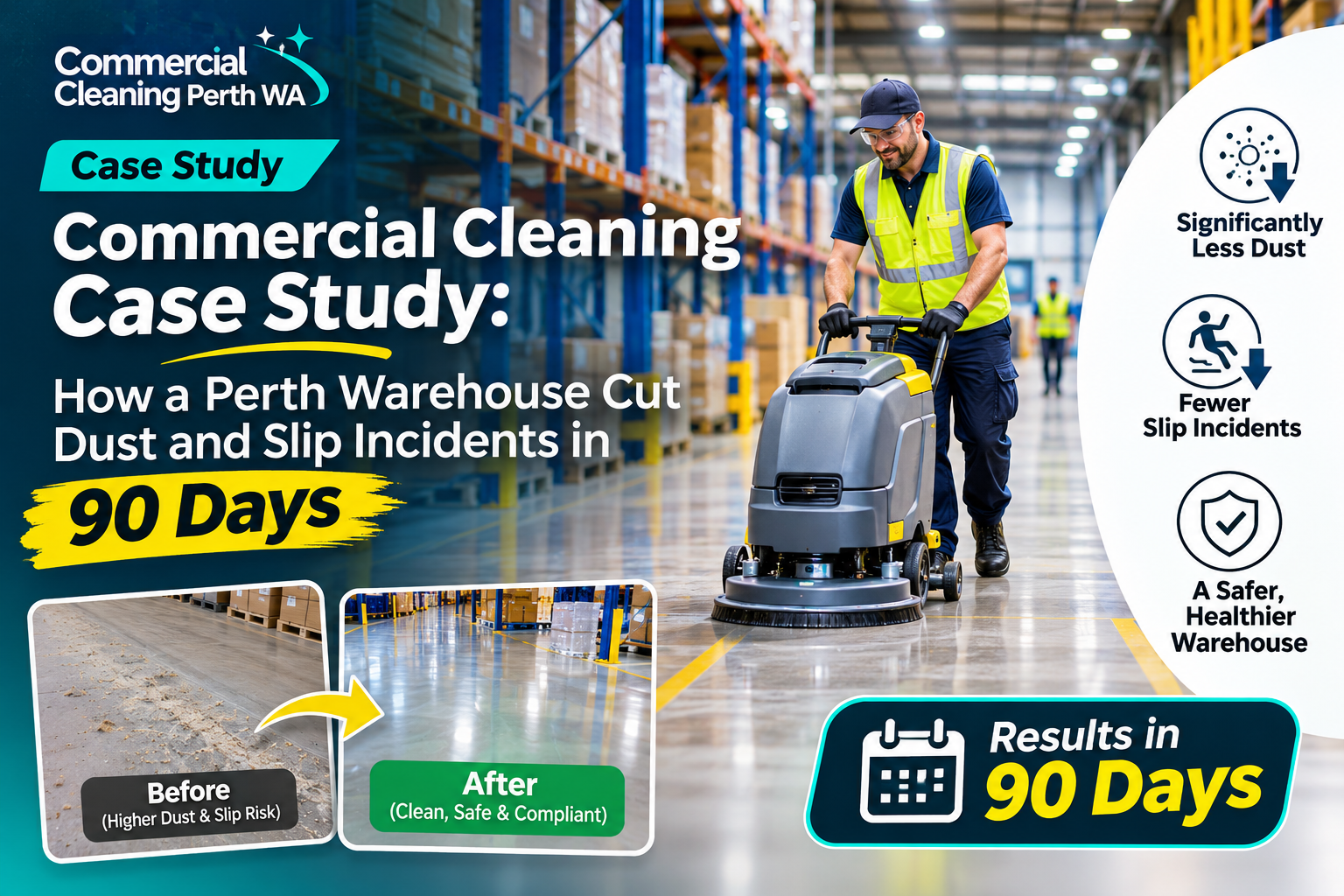
Dust on racking, residue on concrete and the occasional slip near a loading dock are easy to dismiss as part of running a busy warehouse. They are also some of the most preventable risks on site. This commercial cleaning case study Perth businesses can relate to follows a Perth warehouse that set out to reduce airborne dust and slip incidents within 90 days, and what changed in that time.
> Note for editors: Figures in square brackets are placeholders. Replace each one with verified client data, and obtain written client approval, before publishing.
Case Study Snapshot
| Client | Paula Cullen |
|---|---|
| Location | Jandakot |
| Site size | 11,000 sqm |
| Operations | sweep and scrub warehouse floor |
| Timeframe | 90 days |
| Goals | Reduce visible dust, reduce slip incidents, improve audit readiness |
The Challenge: Dust, Residue and Slip Risks
Before engaging a commercial cleaner, the warehouse relied on a mix of ad hoc sweeping by operations staff and occasional one-off cleans. The site manager described the situation to us in three parts.
- Dust build-up. Fine dust collected on upper racking, beams, sprinkler-adjacent surfaces and ledges. It was also being tracked across the floor by foot traffic and forklifts.
- Slippery floor zones. Dock entrances, aisle intersections and areas near the lunchroom had recurring problems. These included residue, spills, moisture tracked in from outside and uneven cleaning coverage.
- No consistent record. Cleaning tasks were completed when time allowed. There was no documented schedule, so it was hard to show what was done, when and where.
What We Did: Our Approach to Warehouse Cleaning
A warehouse is not an office, so a generic cleaning checklist was never going to be enough. The approach started with understanding how the site actually operates. Our warehouse cleaning services in Perth are built around that principle: assess first, then schedule.
Step 1: Site assessment and risk mapping (Week 1)
We walked the site with the warehouse manager and mapped the following:
- High-traffic routes, including forklift lanes, pedestrian walkways and dock thresholds
- Dust-collecting surfaces, such as racking beams, ledges, ducting, lights and high-level areas where safe access is available
- Floor types and conditions, such as sealed concrete, epoxy-coated sections and any worn areas
- Known slip hotspots, based on the client's incident records and staff feedback
- Operating hours, so cleaning could be scheduled around peak activity
Step 2: Initial deep clean (Weeks 1–2)
An initial deep clean reset the site. It typically covered:
- High-level dusting where safe access was available
- Machine scrubbing of main aisles, dock areas and walkways
- Detailing of amenities, lunchroom and office areas
- Removal of accumulated debris from corners, edges and under pallets where accessible
Step 3: Ongoing scheduled maintenance (Weeks 3–12)
- Daily or per-shift: spot checks and spill response in identified hotspots, dock entrances and amenities
- Weekly: machine scrubbing of main traffic routes and dust control on low and mid-level surfaces
- Monthly: high-level dusting rotation and detailed cleaning of less-accessed zones
Each visit was recorded against a checklist so the warehouse manager could see what had been completed and where.
Step 4: Communication and feedback loop
We held a short check-in with the site manager each fortnight to review new hotspots, seasonal changes and any feedback from the floor team. Dust and floor conditions shift with stock movements and the weather, so the schedule was adjusted to match.
The Results: Commercial Cleaning Case Study Perth Outcomes at 90 Days
The table below shows the before-and-after comparison. All values are placeholders until confirmed with the client's own records.
| Measure | Before | After 90 days |
|---|---|---|
| Slip incidents and near-misses (per month) | High Risk | Low Risk |
| Visible dust on racking and ledges (inspection score) | [2 / 10] | [10 / 10] |
| Floor condition audit result in high-risk zones | too dusty | Now clean |
| Cleaning tasks documented and signed off | [20%] | [95%] |
What the numbers meant on the floor
- Fewer slip events. More consistent floor cleaning in known hotspots reduced the residue and moisture that contributed to earlier incidents.
- Cleaner surfaces at height and ground level. Regular dust control meant less settling on racking and less dust moving through the building.
- Better visibility for management. Checklists and regular reviews gave the manager a clear record of cleaning activity, which supports internal safety reviews and audits
Why It Worked
Several factors stood out in this engagement. They are practical points any warehouse can apply.
- Cleaning followed the flow of the operation. Hotspots such as docks and aisle intersections received focus based on actual use, not a generic schedule.
- A reset came before maintenance. Maintaining a poorly cleaned site is far harder than maintaining a clean one.
- Tasks were documented. Written checklists replaced guesswork and made gaps easy to spot.
- The program was reviewed regularly. Adjusting to stock changes, seasons and feedback kept the schedule relevant.
Cleaning is one part of a wider safety approach. It works best alongside the site's own hazard controls, signage, spill procedures and workplace health and safety obligations.
Lessons for Other Perth Warehouses and Industrial Sites
If you manage a distribution centre, storage facility or light industrial site, consider these questions:
- Do you know where your dust collects and which surfaces are never cleaned?
- Are your slip hotspots mapped, and does your cleaning schedule match them?
- Can you show what was cleaned last week, and by whom?
- Does your cleaning plan change when your stock, season or shift pattern changes?
Larger production sites may need a different scope again. Our factory cleaning services cover those environments, and you can browse our full range on the services page.
Get a Site Assessment for Your Warehouse
Every site is different, so we don't offer one-size-fits-all packages. We start with a walk-through, identify your dust and slip risks, and propose a schedule that suits your operating hours and budget.
To discuss your warehouse, contact our Perth team and tell us about your site. We'll arrange a time to assess it and outline the next steps.
FAQ
How long did it take to see results in this commercial cleaning case study?
The program ran for 90 days. Improvements to visible dust were noticeable after the initial deep clean, while changes in incident numbers were measured across the full period.
Can cleaning alone eliminate slip incidents in a warehouse?
No. Cleaning reduces contributing factors such as residue, spills and moisture, but it works alongside other controls like signage, spill response procedures, footwear and safe work practices.
Do you clean while the warehouse is operating?
It depends on the site. We plan around your operating hours, forklift movements and shift patterns, and some tasks may be scheduled out of hours.
Can you tailor a cleaning schedule to my warehouse?
Yes. After a site assessment, we build a schedule around your floor layout, traffic patterns, dust sources and budget.